Author Archive

Dilong (Carnegie Collection by Safari Ltd.)

What’s this – the Carnegie Dilong again? Haven’t we seen it around these parts before? Well, yes, we have. Unfortunately, the original reviewer left the blog some time ago and, for whatever reason, deleted all his posts upon departure. As such, what you are reading now is a replacement – written by me, I’m afraid. So, without further delay, let’s take a good gander at the Carnegie Dilong from 2005. Again.

Dilong paradoxus lived in China in the Early Cretaceous, as did Caudipteryx and Beipiaosaurus (although perhaps not at exactly the same time), both of which have also subsequently made it into the Carnegie Collection. While it’s definitely a plus that this Dilong and the Beipiaosaurus are sculpted at roughly the same scale, Dilong was a somewhat more diminutive creature than Beipiaosaurus (or at least, the type specimen was). As such, fine details are a little more fudged than on the therizinosaur, particularly around the head; the teeth are indistinct while the eyes, apart from probably being a little too large, have asymmetrical splodgy pupils.

Of course, Dilong is most famous for having been preserved with evidence of a fuzzy ‘protofeather’ covering, and fortunately this is far more attractively rendered. The details remain very crisp up close, giving a pleasing impression of a ‘furry’ fluffiness. While the colours could be considered a little conservative, in this case it’s probably actually a good thing – a bright blue (for example) Dilong would actually have been incredibly unlikely, as the nature of ‘protofeathers’ all but prevents this colouration from being physically possible.

Anatomically, this model is very good even if it’s not perfect, and certainly excellent given its very cheap price tag. Perhaps most obviously, the hands do not match up especially well, the real Dilong having quite long hands and fingers of more differing lengths. The tail is also rather thin where it joins the body (not allowing room for muscles), although this was common in palaeoart until fairly recently. Other than that, the proportions are good – the legs are nice and long and the head is deep and narrow, with the characteristic low Y-shaped crest evident.

The Carnegie Collection has, since 2005, been so far ahead of the pack as regards feathered (nonavian) dinosaurs that it’s been a little embarrassing  (although that naked Velociraptor is a very unfortunate black mark), with Collecta only now catching up. Although certain aspects of the sculpt could use a little more finesse, this Dilong is certainly a worthy addition to a lineup that now also includes Microraptor, Oviraptor and of course the aforementioned Beipiaosaurus and Caudipteryx. Hopefully we’ll be seeing a lot more of them – starting with a Velociraptor resculpt!


Parasaurolophus (Soft model by Favorite Co. Ltd.)

Parasaurolophus walkeri is one of the  most widely recognised and much-loved hadrosaur species, and no dinosaur toy line is complete without it. (Sorry, P. tubicen and P. cyrtocristatus.) It’s only proper, then, that Favorite include it among their ‘soft model’ lineup. As (almost) always, they’ve done an excellent job.

I’ve critcised the Favorite ‘soft’ dinosaurs in the past for their bland, uninspired paint jobs – tending towards greyish brown and brownish grey (with dark green as an occasional special treat). As if to make up for it, their Parasaurolophus is an absolute colour riot. The bright red pompadour is, of course, just traditional, but I absolutely love the vibrant greens and yellows and spotted  back on this model. The only thing stopping this figure from receiving top marks in the paintjob department is a slight sloppiness with the fine details – specifically, on the hands. While all the digits on the left hand have painted claws, the right hand lacks them entirely (see below). Still, this is only a very minor fault, probably peculiar to the one that I own.

Anatomically, it’s hard to think of any mass-produced plastic Parasaurolophus figures that are better than this one, or even the equal of it, except for the sadly long-discontinued Battat. Unlike many Parasaurolophus figures, this one does not have a super-skinny, swan-like neck, and is therefore more in line with modern thinking on the anatomy of these dinosaurs. The proportions are excellent, although the spine may be a little lower than it should be over the hips. In addition the shoulder girdle might be rather too high – see this Scott Hartman skeletal from last year – although this sculpt is a few years old now (I was going to credit Niroot for pointing this out to me via Twitter, but have you seen the size of that guy’s ego? It’s ENORMOUS).

I’ve always liked the Favorite models for their very crisp detailing and clean finish. As is common to all the Favorite ‘soft’ models of scaly-skinned dinosaurs, this Parasaurolophus has all-over scalation. One could argue that since the scales on the real dinosaur would have been much, much smaller than this (to scale), such detailing is actually unrealistic. In the past I have tended to view the scales as a plus in that they help give a better impression of the scaly nature of the animal’s hide, and fade into obscurity when viewed from a distance anyway; however, it’s all a matter of personal taste. This is also true of the creature’s mouth, which on this model has been rendered cheek-free. I’ve always favoured ‘cheeks’ for no particularly good scientific reason, but that issue would appear to be unresolved for the time being. In any case, since the mouth is closed this hardly detracts from the figure overall.

I’m waffling far too much about tiny, nitpicky things again, though. Taken as a whole, this is an excellent figure and a worthy addition to anyone’s hadrosaur collection. What’s more it is, as a plastic figure, cheaply available where sold. Recommended.


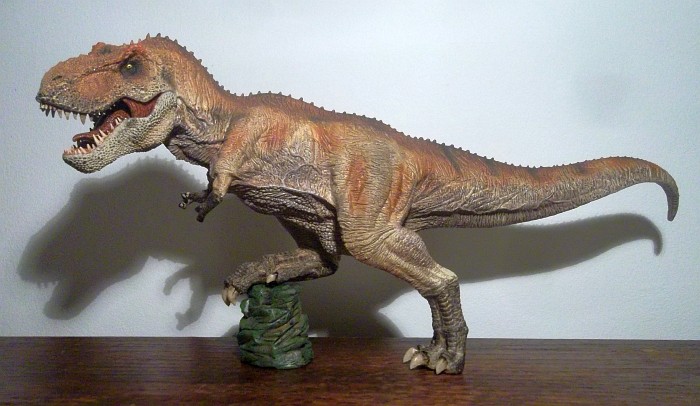
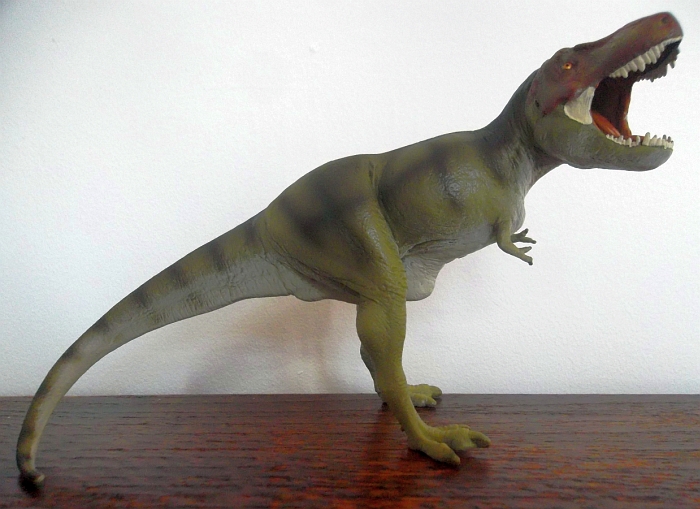
Tyrannosaurus (Desktop model by Favorite Co. Ltd.)

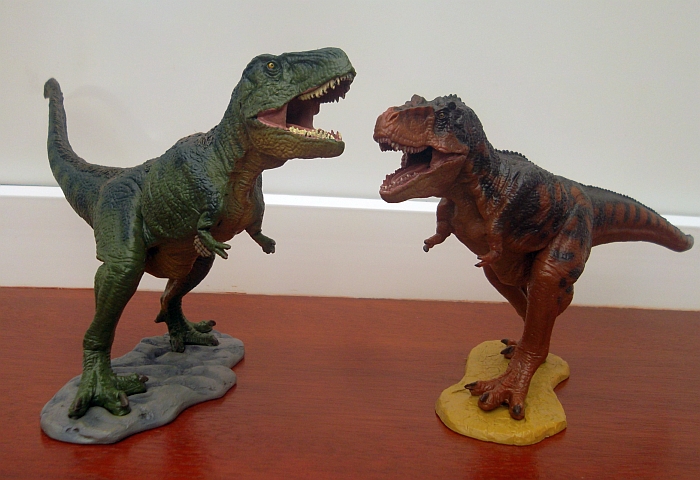
Back in 2010, Favorite released a re-sculpt of the Tyrannosaurus from their resin ‘Desktop’ range, alongside Triceratops and Allosaurus. Once again, it is a huge improvement over its predecessor anatomically but is likely to strongly divide tastes.

Just as with the Allosaurus, a large, overhanging ‘lip’ covers all of the teeth in the upper jaw, with only the very tips visible on close inspection. This is in marked contrast with the majority of Tyrannosaurus figures, which – by design – appear to emphasise their subject’s huge, intimidating dentition (occasionally to an exaggerated degree, like the teeth are dangling from their roots). On the mandible, the gumline is drawn back to allow space for the upper teeth. On the whole, this is not unlike the Komodo dragon or indeed some modern carnivorous mammals (although the latter, of course, have muscular, mobile lips).

This is bound to be the most divisive aspect of this figure, especially from an aesthetic point of view. Some people are going to be seriously put off by the ‘lip’, believing that it makes  their pet monster look rather, well, toothless. Personally, I must admit to finding the look a little offputting at first. However, it is – for now – actually quite plausible. At the very least, it gives the figure a distinct, even distinguished look. The sculptor hasn’t tried to produce some dragon-like monster that they think will look cool to kids (and big kids) – they’ve done their best to sculpt a restoration of an animal that really existed. The only shame is that the teeth that are visible are somewhat rounded and blunted, presumably to prevent breakage, which detracts from the look somewhat. A little more finesse wouldn’t have gone amiss there.

That said, this is still a sculpt with excellent attention to detail. Thankfully, the ‘prodded with a coffee-stirrer/Biro lid’ look of the Allosaurus is not replicated here – instead, the plausibly bulky and muscular creature has been furnished with well-executed scalation, skin creases and sags. The painting is virtually immaculate, right down to the tiny hand claws and shark-black eyes. In terms of colouration, the model is perhaps best described as being a deep claret red on top, marbled with swirling black, and grey below. It is attractive and stands out while remaining suitably subtle and subdued, again in contrast with the bright blue Allosaurus.

From an anatomical point of view this is one of the best mass-produced Tyrannosaurus figures available, and very difficult to fault. ‘Lips’ aside, the body is near-perfectly proportioned – the arms are, for once, just as miniscule as they should be – while the barrel chest, huge thighs and thick, muscular tail are all true to the real tyrant reptile. Someone has really done their homework here. This somewhat robust rendition of Tyrannosaurus also stands in contrast with a number of rather skinnier models that have been produced down the years, and (although produced in 2010) the look of the figure fits neatly with recent research.

In the end, though – thanks to that ‘lip’ – you’ve probably already decided whether or not this figure is one you’d like to go for. The price is worth mentioning, too – at about 30cm (or a foot) long, this figure can be rather expensive to obtain for its relatively small size (mine was a Christmas present). In spite of such issues, I think this is a well-executed figure and I’d highly recommend it to anyone seriously into collecting up-to-date dinosaurs.


Brachiosaurus (Dinotales Series 2 by Kaiyodo)

Ah, Dinotales. You either love them, or you’re wrong. Although tiny, their finely-sculpted, pointy and brittle nature ensures that they are inherently unsuitable for use as toys; it also means that they combine the two desirable traits of being attractive and compact (particularly handy for the more fanatical collector who’s running out of space). This one, although labelled “Brachiosaurus“, actually more closely resembles the African brachiosaur Giraffatitan brancai, as is the case with so. Many. Figures. Most of which, in fairness, predate the animal’s reclassification – as everyone’s bored of hearing by now, it used to be regarded as a Brachiosaurus species, and as it was more ‘complete’ it became the typical representation of Brachiosaurus in palaeoart and pop culture.

What makes me so sure it’s Giraffatitan? Well, I did deliberate over it for a while, I must admit. However, the anatomical proportions appear to be wrong for Brachiosaurus altithorax – the torso and tail aren’t proportionately long enough (although the latter is quite long, admittedly) and the animal is overall too gracile (compare this figure with the B. altithorax skeletal in Mike Taylor’s 2009 paper). Granted, the head doesn’t quite match Giraffatitan, but I’ll put that down to the difficulty of sculpting and mass-producing a figure at this tiny scale. And it really is tiny – at about 12cm long and 6.5cm tall, it is dwarfed by the majority of sauropod figures. That doesn’t stop it being a beaut, though.

‘Elegant’ is perhaps the best word to describe this figure. Like so many Dinotales figures, the slavish attention to detail and adherence to anatomical accuracy is simply wonderful. It’s not completely perfect (I’ll get to that in a minute), but there is so much that’s done correctly here that so many others have got wrong – especially (oh yes) the hands and feet. Even though they are miniscule, the best attempt has been made to make each hand a ‘collonade’ of digits with only one claw, while the crispness of the detailing – skin folds, musculature and all that – is incredible. I’m also a huge fan of the intricate colour scheme. On the one hand, you might think that this sort of colour scheme is unlikely for such a big, herbivorous animal. On the other hand, it has been argued that camouflage might have been a bit pointless for an animal bigger than a house. Whatever the case, it’s far superior to the usual boring greys, greens and sludgy browns.

If there’s one problem I have with this figure, it’s that it might be a little bit too skinny and gracile, especially when it comes to the neck. Owing to the figure’s small size, it’s not as much of a problem as it is for eg. the Favorite “Brachiosaurus, but it is still a little irksome – depending on your opinion, of course. I’ll admit to having been convinced by Matt Wedel that brachiosaur necks probably shouldn’t be ‘caved in’ like this (especially as he produced a chucklesome image – “feed me pls”), mainly because he’s a bona fide Sauropod Expert. The fact that these indentations are there at all on such a tiny figure is remarkable, mind you, which does make one feel like a bit of a grumpy, pedantic git (who, me?) for wishing they weren’t, but there ya go. The neck could probably do with being a bit deeper down near the shoulders, too, to allow for all the tendons and muscles.

This is all relatively minor nitpickery, though, especially on a figure of such a small size. I certainly wouldn’t hesitate in recommending this figure to anyone; it’s a better-than-most sculpt with a very attractive paint job (as with pretty much all the Dinotales models, there are alternative colour schemes out there, but I think this is my favourite). It’s also very cheap, especially if you live in the Far East. Now, go and nab it on eBay!