Author Archive

Apatosaurus (Carnegie Collection by Safari Ltd.)

Review and photos by forum member Gwangi, edited by DinoLord

Everyone familiar with dinosaurs knows the name Apatosaurus, and those not familiar with dinosaurs probably are familiar with it but still call it Brontosaurus despite a name change over 100 years ago. I won’t bother getting into any of that as anyone reading this review most likely already knows the story. Let’s just say that whenever I talk about dinosaurs with the average person I’m forced to describe any sauropod as “you know… like Brontosaurus.” I’ll admit, I prefer the former name over the current but it is what it is and ultimately has little to do with the figure I’m reviewing.


It was the year 1988: I was four years old, the “Dinosaur Renaissance” was about two decades in and the book “Jurassic Park” was two years away from publication. Dinosaurs were still frequently depicted as they were in days past. Only a year previously Invicta released it’s rendition of the famous Apatosaurus, tail dragger and all but a new brand of dinosaur figures was about to be released, one that would reflect the knowledge of the time and ultimately out compete Invicta. Though outdated by today’s standards, the original Carnegie Collection was unlike any other toy dinosaurs at the time and their Apatosaurus was one of those toys.

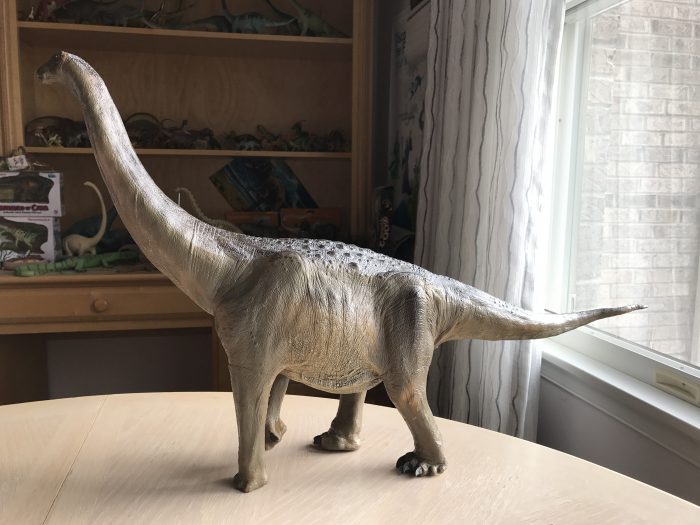
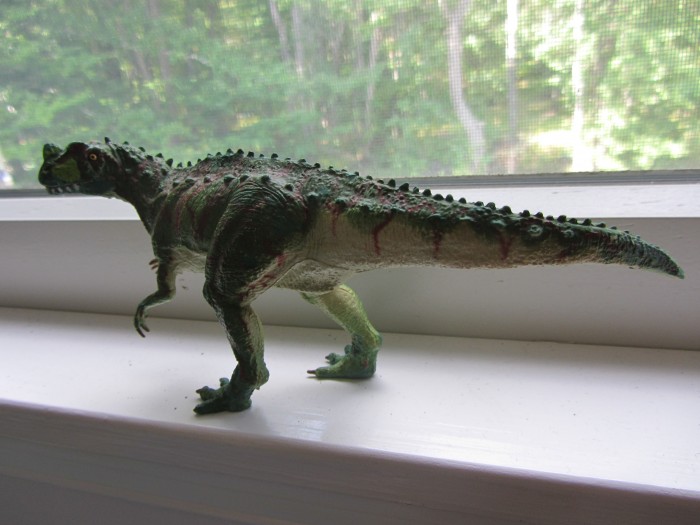
The Carnegie Apatosaurus is a big one and depending on which version you own would measure 5” in height and 21-23” in length if not for the bend in the neck and tail, this
length puts the figure at about 1/40 in scale. It is also quite heavy weighing in between 1-2 lbs again depending on the version you own. Mine is the smaller 1996 version but was pre-dated by another in 1994 and as said the original in 1988. The colors also vary depending on which year the model came from. The two later versions are the Carnegie
standard greens with a darker pattern dorsally. The original was grey and tan and where color is concerned honestly better looking in my opinion. The figure is well textured with
many wrinkles and scales with more of the former as seems to be the Carnegie tradition.

The original 1988 version of the Carnegie Apatosaurus (with the baby Carnegie Apatosaurus figure). Note the different color scheme, more "humped" back, and different tail. Photo by forum member webdragon.

The overall stance of the figure is quite dynamic. The newer model strides forward with a low slung tail that curves up. It is important to note that the tail does not drag on the
newer models but in the older the tip does touch the ground. The neck curves up and back down with the head veering towards the left. It gives the appearance that the animal is
looking for food or at some unseen predator or perhaps its offspring; a baby Apatosaurus was also released with this model but will not be reviewed here.

The model has a lot of bulk to it, though small compared to the real thing you get a sense of size with this figure. The proportions are fairly good, but I think the figure could stand
a bit taller. The front legs are shorter than the back as should be but the feet are huge and inaccurate, but given the release date it is forgivable. The current consensus is that with
sauropod feet only the thumb claw could be seen on the front and the first three in the back. These large inaccurate feet are common with the older Carnegie sauropods; I can
understand the number of toe nails but why the large feet I can only guess. All the toe nails are painted grey.

The head is appropriately small but could probably be smaller; the neck is beefy but could probably be beefier and a bit longer. The head is the right shape. No Camarasaurus
skull on this guy. However, the paint job leaves a lot to be desired. The mouth is a sloppy pink line and the teeth merely white spots painted on randomly. The nostrils are high up on
the head as was the mindset of the time. Currently it is thought that they were closer to the front of the snout. The eyes are yellow with black pupils. Along the back and tail
a prominent ridge has been sculpted which accurately reflects the tall spines the actual Apatosaurus had. The tail comes close to the ground or touches it in older models when
it should be held higher but the figure still looks good regardless. The tail is a bit on the short side and lacks the long thin tip but being a toy this should come as no surprise.

Overall what we’re left with is a well made but dated Apatosaurus that seems to walk the line between the old school and new school way of thinking in terms of what dinosaurs
were like. It is still a handsome figure essential to any sauropod collection unless you’re the type who only wants the most accurate figures, but keep in mind that what is accurate
now may not be in a matter of years or even days. If you’re a Carnegie collector this one will have to do as they have yet to release an updated version.

Gallimimus (Battat)

Photos by Niroot ‘Himmapaan’ Puttapipat

Ornithomimids are a horribly under-represented family of dinosaurs when it comes to dinosaur toys. For such fascinating animals, this really is a shame. Fortunately, the few ornithomimid figures out there are usually quite well-made. The Battat Gallimimus is one of these.

null

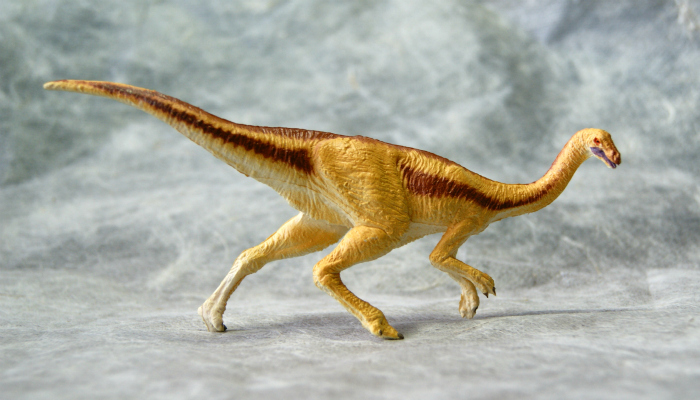
Made in 1994 (a year after the dinosaur’s appearance in Jurassic Park I should add), this Gallimimus is part of the now revered and rare Battat line, made for the Boston Museum of Science. Like the other figures in this line, the Gallimimus is an excellent sculpt and is quite accurate despite being almost 2 decades old. All the proportions are correct, and the wrists are not pronated (always a plus). The shape of the head is well-done, and the eyes are the appropriate size too.

In addition to being accurate, the sculpt is very well-detailed as well. The musculature in the hind limbs is well defined. For an animal that was probably a swift runner and relied on running as a method to escape predators, this makes sense. The skin detail is excellent as well, with realistic looking wrinkles and small scales. This is a detailed sculpt with no sloppiness whatsoever.

null

The quality of no sloppiness also applies to the paint job of this figure. Unlike many other massed-produced figures, the Battat Gallimimus is painted very precisely. The eyes and claws on the hands and feet are especially well painted. The color scheme of this figure is rather pleasant too. It’s just a sandy yellow with brown stripes that fades into a white underbelly, but it looks very natural for an animal that lived in a desert environment.

null

If there is one complaint to be made about this sculpt, it is the lack of feathers. Nowadays, it is thought that many theropods, ornithomimids included, had a covering of “protofeathers” on their body. However, Battat really can’t be blamed, as it was sculpted before this was known. The first feathered non-avian dinosaur was discovered in 1996, two years after this figure was released. If you can get past the lack of fuzz, this is still a very accurate figure.

null

All in all, this is an excellent and well-made figure. If you can get past the lack of feathers, it’s a very accurate figure as well. As one of the few ornithomimid figures (there are no more than 4 I can think of at the moment), it is a must-have for any fan of this family of dinosaurs. Unfortunately, this figure, along with the rest of the Battat line, has been retired for a bit over a decade and is rather rare. Luckily, it is only one of the moderately rare Battats, and pops up on eBay every now and then. If you have a chance to get this figure you certainly should; you won’t regret it.

Many thanks to Niroot Puttapipat for providing the photos for this review. He very graciously sacrificed his own figure by taking it out of its box. Besides being an excellent photographer, Niroot is also an outstanding professional artist. Show your appreciation by visiting his DeviantArt page, which features many wonderful dinosaur illustrations and much much more.

Male Velociraptor (Jurassic Park III by Kaiyodo)

The Jurassic Park movies are what led Velociraptor to its great fame and popularity in popular culture. This dinosaur has been represented many times in Jurassic Park memorabilia, collectibles, and toys. It is fitting that when Kaiyodo produced a set of 13 figures based on the dinosaurs of Jurassic Park 3, figures of both the male and female Velociraptors in the movie were produced. Today we will take a look at the male Velociraptor figure.

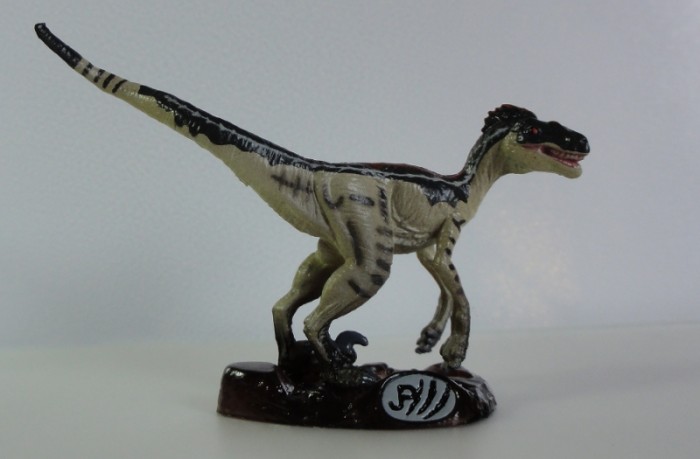
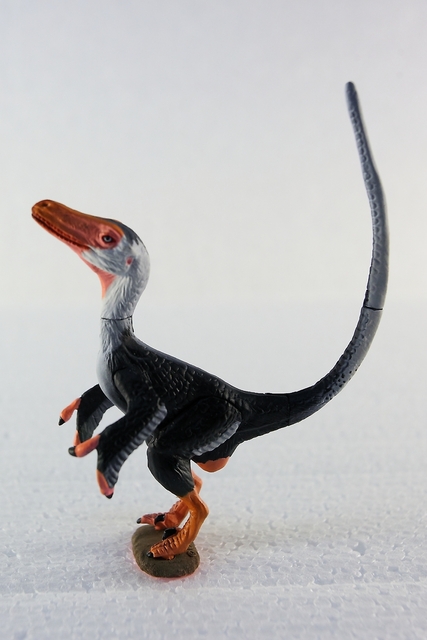
Unlike most theropod figures, this Velociraptor is in a rather static pose. Instead of roaring or preparing to attack, it is simply walking, perhaps eying something in the distance. The sculpt is an excellent one. The detailing is exquisite for a figure only around 3 inches (7.6 cm) long. The musculature is well defined, and the skin is detailed with natural looking skin folds, as well as scales and pads around the feet and hands. Even the teeth are well detailed and painted. In addition, the figure has a small row of feathers along the back of its neck. Just like the similarly sized Dinotales figures, this Velociraptor has an excellent sculpt despite its small size.

However, this sculpt is not without its flaws. Since this Velociraptor is intended to represent a movie “monster” and not a scientifically accurate portrayal of the animal, one can ignore the major inaccuracies such as the pronated hands, deep skull, and lack of feathers. But the sculpt has some differences from the male Velociraptor seen in Jurassic Park 3. For one, the hands are too large. The shape of the head is slightly off. In addition, the feathers on the back of the neck are too plentiful. In the movie, they are rather sparse, unlike the dense Mohawk of this figure.

In addition, the paint job on this Velociraptor is not completely movie accurate. In the movie, the male Velociraptor is mainly a mixture of blue and brown. However, the paint scheme on this figure is mainly a light cream color with blue markings. In addition, the feathers have light markings on them, while the feathers on the figure are a solid blue. However, the paint job is not completely bad. While not as of high quality as some of the later Dinotales figures, the paint job is still quite detailed. The teeth are all individually painted, and the eyes are well painted, which gives them a malicious expression.

Despite its flaws, this Velocirapor is a nice little figure to have, especially for Jurassic Park fans. Acquiring it, however, is not too easy. The set that this Velociraptor was part of was only sold in Japan, and is likely to be long retired. Luckily, this figure is one of the more common ones out of the set on eBay, and can be found in both individual auctions (for no more than a few dollars) or in listings selling the entire set (for around $40). If you are a Jurassic Park fan or just a fan of theropods in general, you should look into acquiring this figure sometime.

Spinosaurus (Furuta)

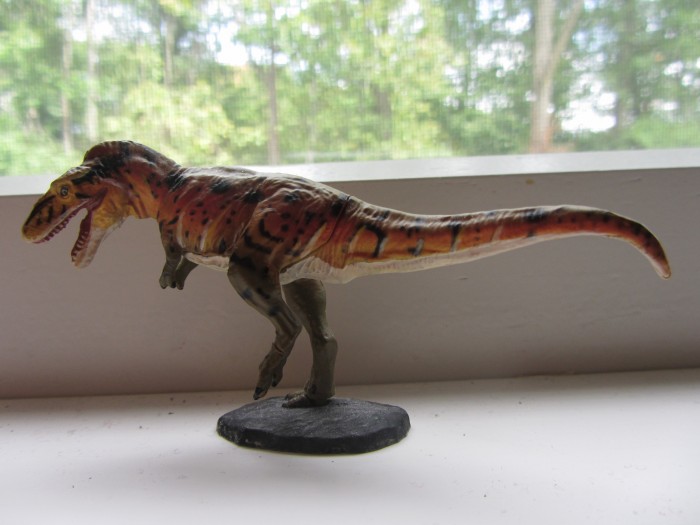
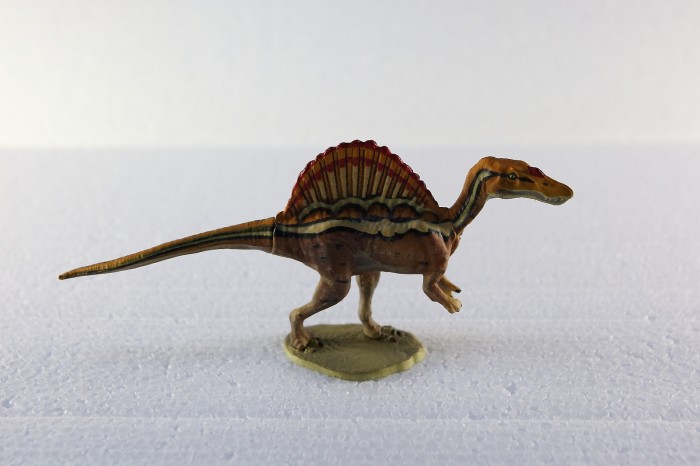
Ever since it starred in a certain film in 2001, Spinosaurus has found its way into the hearts and minds of the general public and fanboys. Featured killing a sub-adult Tyrannosaurus in the movie, Spinosaurus has gained a reputation of being ferocious and omnipotent. This is reflected in many figures of this dinosaur, such as the offerings by Carnegie and Sideshow, which feature the dinosaur in a very active or at least roaring pose. However, the Spinosaurus figure by Furuta is featured in a much calmer pose, with its jaws closed (the poor fellows need to close their mouths sometimes).

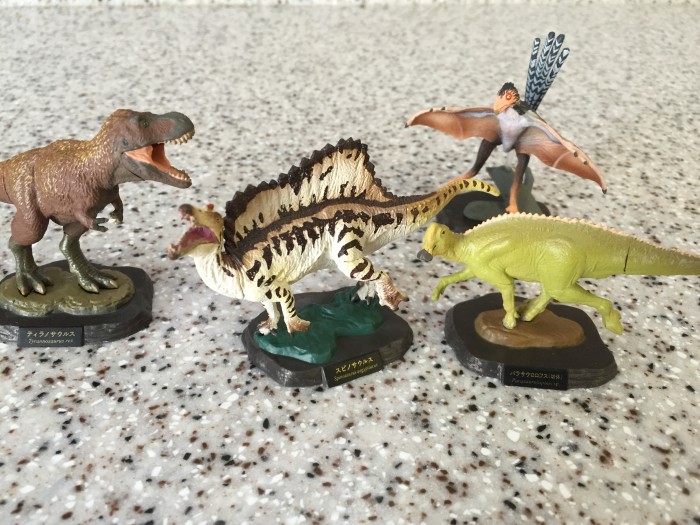
One of the first things that comes to mind when looking at this figure is its rather vibrant color scheme. Similar to the Kinto Soft Model Spinosaurus, the Furuta Spinosaurus is quite orange. However, this figure is less garishly colored, with the body being a light brown. A cream colored line outlined with black and red markings adorn the body and the distinctive sail. The eyes and claws are painted with good detail, something that most figures lack. Its bright color scheme makes this neat little Spinosaurus figure stand out in any collection.

In addition to its unique paint job, the Furuta Spinosaurus has a great sculpt of well. Since Spinosaurus is known from very few fossil remains, some liberty can be given about accuracy. From what is known of the dinosaur, this figure appears to be quite accurate. The proportions don’t appear to be inaccurate, and the fact that the figure stands on two legs (thanks to the help of a base) is always a nice touch. Also, there is the fact that this figure is not roaring. This is quite natural, as the average predator doesn’t have its jaws opened constantly. The detailing, while not absolutely exquisite, is still nice, with mainly wrinkles and some scales on the feet (it is likely that the scales wouldn’t be very visible on a figure of such a small scale anyways).

However, there are some faults to be found with this figure. First of all, the figure is a very thin depiction of Spinosaurus. Even the sail shows all bones in it. In real life, a large apex predator such as Spinosaurus would probably be more muscular. In addition, the shape of the skull is inaccurate. The distinctive subnarial gap, while somewhat present, is not at all prominent when it should be very prominent. Finally, the arms should be larger with larger fingers and claws. From what we know of other spinosaurid remains, Spinosaurus most likely had large muscular arms and large claws on its fingers.

Despite some inaccuracies, the Furuta Spinosaurus is still a neat little figure worth having. However, the figure is only available for sale in Japan (Furuta is a Japanese company). If you wish to acquire it, then eBay is your best bet, as it is occasionally on sale there for no more than $10. If you are a fan of spinosaurids or theropods in general, this figure is certainly worth acquiring.